Hair growth cycle (anagen, catagen, telogen, exogen)
Each scalp hair follicle cycles on its own through a long growth phase (anagen), a short transition (catagen), a resting phase (telogen) and shedding (exogen), which is why losing some hair every day is normal.
Full definition
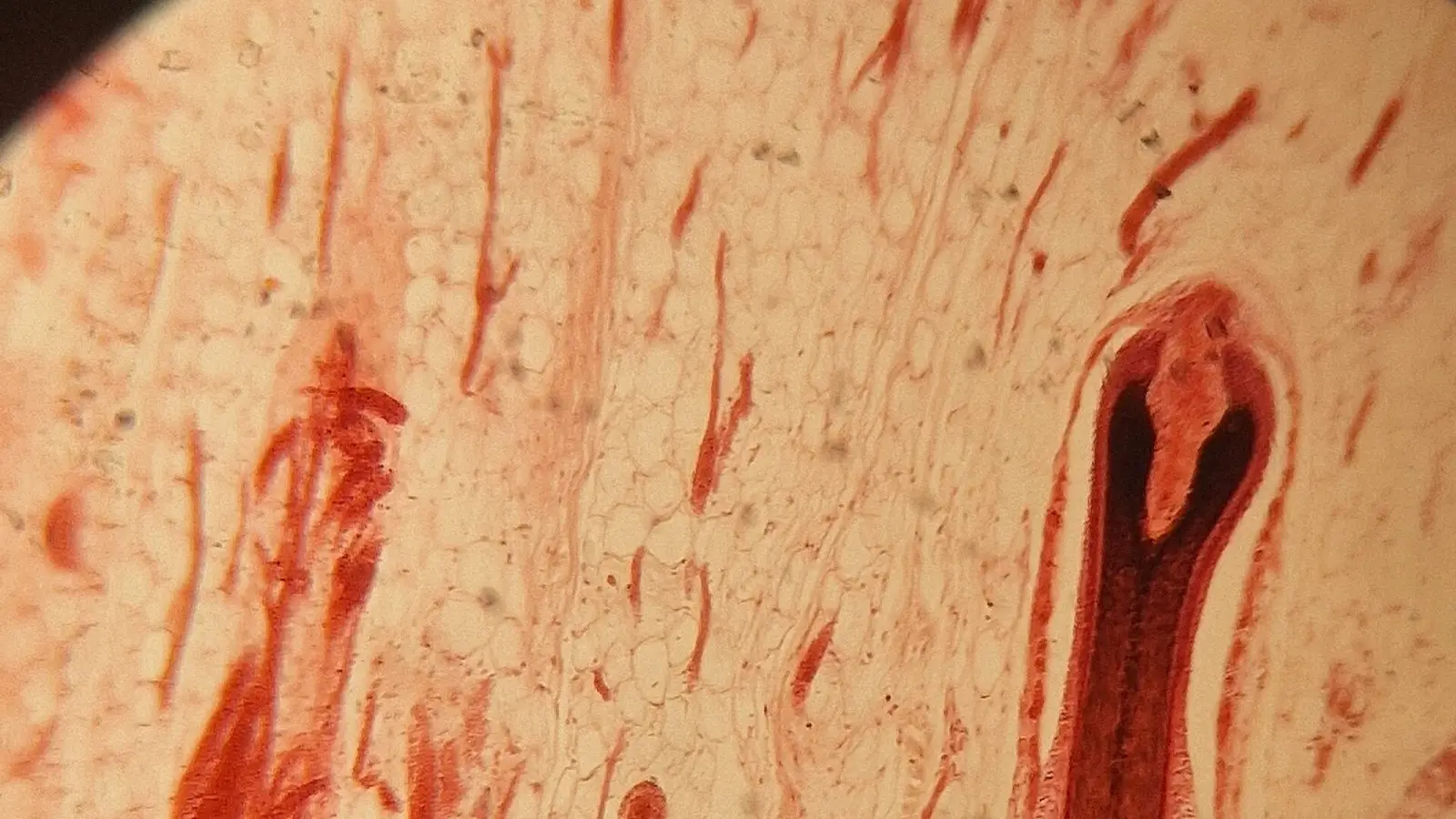
Hair does not grow continuously. Each follicle runs through repeated cycles, independently of its neighbours, so the scalp as a whole keeps a fairly steady amount of hair. Anagen is the growth phase, and for scalp hair it lasts roughly two to eight years. Catagen is a transition of about two weeks, in which the follicle stops growing and shrinks back. Telogen is the resting phase, lasting about two to three months. Exogen is the shedding step, in which a new hair growing up from beneath pushes the old one out (Natarelli and colleagues, 2023). The British Association of Dermatologists estimates that around 85% of scalp follicles are growing and around 15% are resting at any one time, and that most people lose between 30 and 150 hairs a day as part of this cycle (estimates vary between sources). When something disrupts the cycle, such as illness, childbirth, major stress or a new medicine, many more follicles can switch into the resting phase together. The extra shedding often starts around three months after the trigger, which is telogen effluvium. In pattern hair loss the problem is different: the growth phase gets progressively shorter and the follicles undergo miniaturisation. The cycle also explains two things people often find puzzling about treatment. First, results take months, because hair has to work through the cycle: the Propecia SmPC says three to six months of daily use are generally needed before hair loss stabilises (how long finasteride takes to work). Second, the BAD notes that minoxidil can cause extra shedding in the first 4 to 6 weeks, as hairs at the end of their cycle are replaced by new growth (minoxidil shedding).
What it does not mean
Finding hairs on your pillow or in the shower does not by itself mean you are losing your hair: some shedding every day is part of a normal cycle. Equally, "resting" does not mean a follicle is dead; a telogen follicle normally goes on to grow a new hair. A sudden rise in shedding is a reason to get it checked, not proof of permanent loss.
UK regulatory source
British Association of Dermatologists patient information leaflet, Telogen effluvium, October 2025; British Association of Dermatologists leaflet, Hair loss: male pattern, June 2024; Natarelli N et al. Integrative and mechanistic approach to the hair growth cycle and hair loss. J Clin Med 2023 (PMID 36769541); Propecia 1 mg SmPC section 4.2